

The Challenge of Being Found (and Understood)
Having a digital presence is no longer enough. Today, thousands of companies compete for the same space in search results, and Google no longer simply crawls words—it interprets meanings.
Added to this is a new actor: generative artificial intelligence. Tools like ChatGPT or Google’s AI-generated results don’t just show links: they summarize, compare, and recommend. If your content isn’t structured in a way that these tools understand it, you simply won’t appear.
The question is no longer “Do you have a website?” but rather “Is your website understandable?”
And it is not (just) a matter of being readable and understandable; I am talking about being understood by humans—meaning it is comprehensible, engaging, attractively designed, and useful—and by machines—with content broken down into blocks and cross-referenced against structured data that eliminates the ambiguity inherent in human communication.
It looks like a lot of work. It is, but the context is unforgiving.
2026 already promised to be demanding: digital competition is intensifying, markets are moving fast, and discovery channels are evolving every quarter. In this landscape, ensuring your business is found—and understood—is no longer optional; it is a fundamental requirement for competitiveness.
Let’s take a look at structured data, which will serve us well for both traditional SEO—which has been around for over 20 years—and the new GEO, an AI-oriented adaptation of SEO. Ultimately, it all comes down to web positioning and SEO; the rest is a matter of knowledge and strategy.
WHAT IS STRUCTURED DATA?
Practical definition
Structured data consists of invisible tags added to your website’s code to explain to search engines what each item is—such as a product, service, course, company, or location.
They do not change what the user sees, but they transform what Google and AIs understand.
Analogy: from the disorganized catalog to the card index system.
Imagine a library with no classification system. The books are there, but finding what you are looking for is a matter of luck.
Now imagine that same library with a standardized cataloging system: each book has an author, subject, year, and exact location.
Structured data does the same thing with your digital content.
How it works for an SME
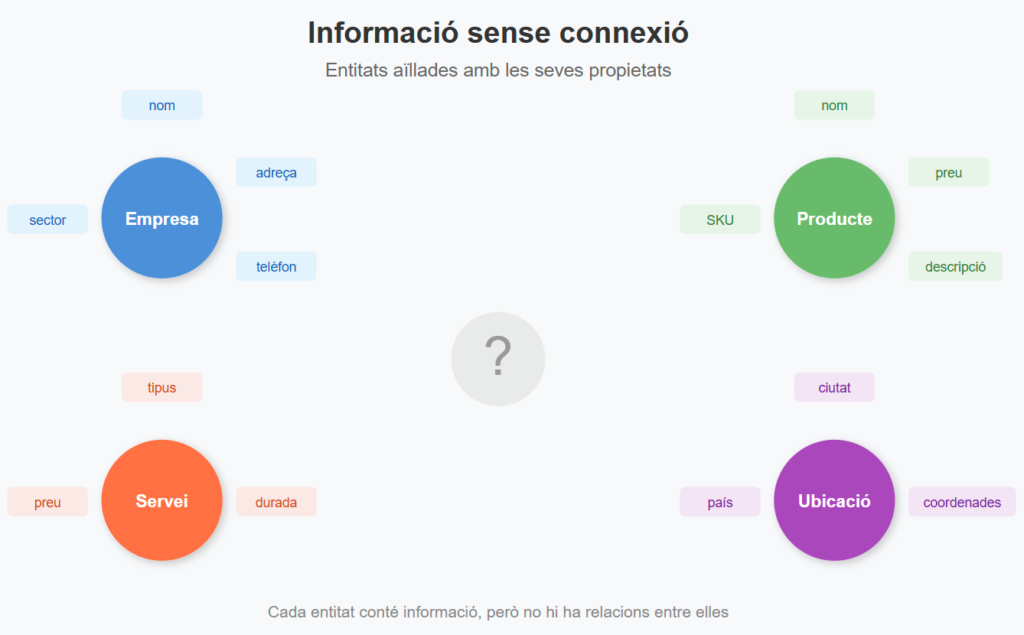
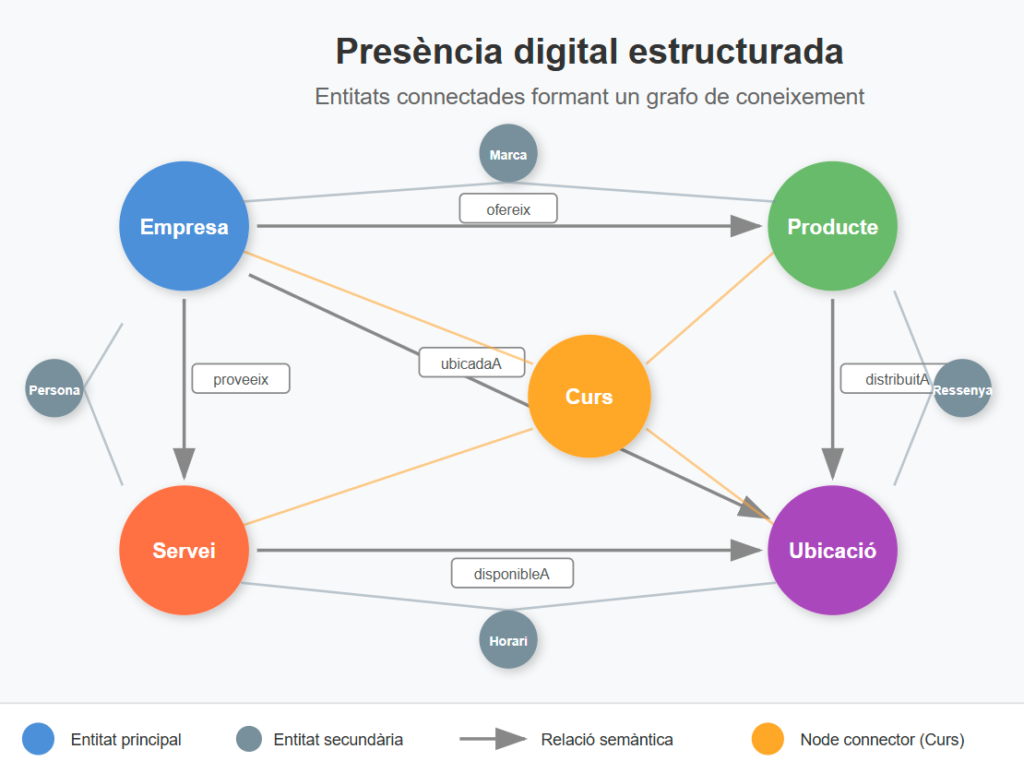
A distribution company might have a perfectly adequate website, but if Google doesn’t know that it operates in Catalonia, distributes industrial machinery, and offers after-sales service, it won’t appear when someone searches for exactly that.
With structured data, each piece of information is tagged and connected.
How it works for a training offer
A course is more than just a title and a price. It has a subject matter, a duration, a delivery format, a target audience, and an accredited provider. Structured data makes all of this readable for search engines—and ensures the course appears when it truly matches what the user needs.
WHY THEY MATTER FOR YOUR BUSINESS
Google visibility: rich results
When Google clearly understands your content, it can display it prominently—featuring star ratings, prices, dates, and expandable FAQs. These rich results attract more attention and generate more clicks than standard results.
Visibility in Generative AI: Being Cited, Not Just Found
Generative AIs don’t list links; they provide answers. If your content is well-structured, you are more likely to be the source the AI uses to construct its response. This is visibility that doesn’t rely on clicks.
Case study: a well-structured course vs. one that is not.
Consider two accounting courses. The first has a page with a title, description, and a registration button. The second also incorporates structured data indicating: subject matter (financial accounting), duration (40 hours), format (in-person), level (advanced training), and organizing entity (accredited).
When, for example, someone searches for accounting courses on Google or asks an AI about them, the second (structured) course has a much better chance of appearing—and appearing prominently.
PRACTICAL APPLICATIONS FOR SMES AND RETAIL
Products and Services
Each product or service can have its own semantic profile: what it is, who it is for, what problem it solves, its price, and the guarantees it offers. This makes it possible to compete in specific searches, not just generic ones.
Events and Training
Courses, conferences, seminars: all benefit from indicating dates, location, modality, available places. Google can display this information directly in the results.
Location and scope of action
A company operating statewide is not the same as a local business. Structured data makes it possible to precisely define the geographic area, which improves relevance in local searches.
Example: exporting company vs. local business
An exporting company can structure the regions where it operates and the markets it serves. A local business can highlight its neighborhood, opening hours, and local services. Each competes where it makes the most sense for them.
HOW TO TELL IF YOUR WEBSITE IS READY
Warning signs: when Google doesn’t understand you
- Your Google results are “flat” (without stars, prices, images, or highlighted information).
- You do not appear in specific searches for your sector.
- Your Google Business profile is not connecting to your website content.
- AIs do not mention you when they answer questions about your field.
- Or conversely, your website appears when it shouldn’t.
For example, showing up for repair services when your company specializes in distribution.
First steps without relying on technicians
- Check if your website has basic markup (Organization, LocalBusiness, Product, Course; this may vary depending on the case).
- Use Google’s free “Rich Results Test” tool to see what Google detects.
- Use the free Schema.org validation tool.
This is the official standard and the easiest way to add structured data to your website.
It is also the method recommended by Google. - Verify that the structured data matches what is visible on the website.
The reality: no website is fully prepared.
In my experience working with SMEs and institutions, hardly any website starts out with a complete semantic structure—and that’s normal. Until recently, no one asked for it.
The real shift lies in understanding that this is no longer just a technical add-on, but part of the business’s digital governance. It is not a one-off, self-contained project, but rather an ongoing process of structuring and connecting information.
Why it is a process, not a closed project
Your business evolves: new services, new markets, new content. The semantic structure must evolve along with it.
The value of a coherent and connected digital presence
When all your business information is structured and interconnected—website, Google listing, professional profiles, industry directories—search engines and AI build a clear, reliable picture of who you are. This is what generates long-term digital authority.
INVESTING IN CLARITY IS INVESTING IN COMPETITIVENESS.
Structured data is not a technical fad; it is the language that allows your business to be understood in today’s digital landscape. Implementing it is an investment in visibility, credibility, and competitiveness.
And the best time to start is now, before your competition does.
Ricard Menor, consultant specializing in semantic SEO and structured data.